DotRepo
Understand a repository. Carry decisions forward.
Conservation through cooperation
We’re building a collective memory that connects what publishers know with work consumers can reuse.
Explore the shared approach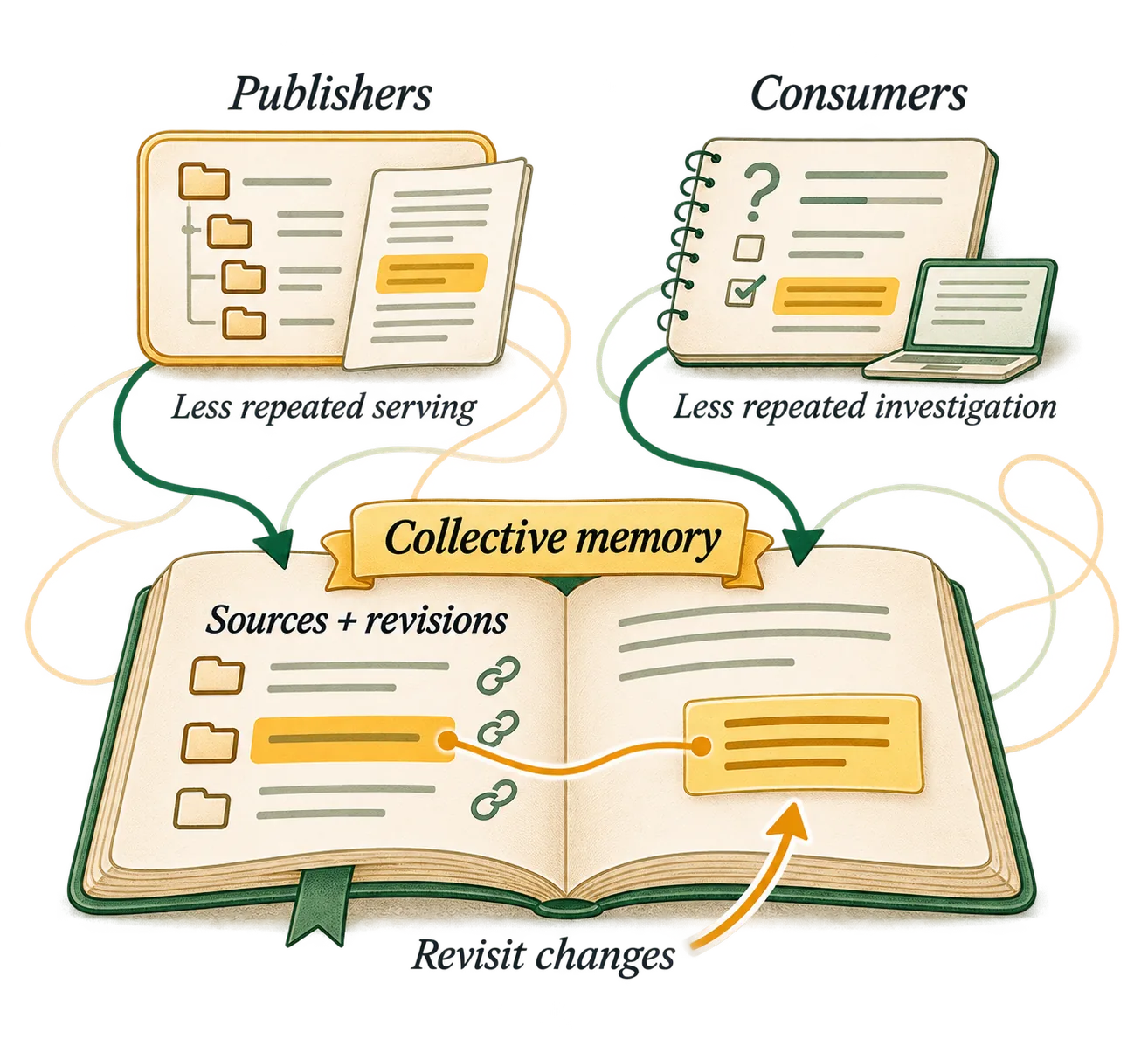
Understand a repository. Carry decisions forward.
Notice what changed. Revisit affected work.
Tools today. A shared memory to build together.
A better meeting point
People using information need answers they can rely on. People publishing it need sustainable serving costs and control over their work. Repeated fetching and ever-higher barriers can make both jobs harder.
There is another direction: make cooperation useful. Publishers already know their sources. Consumers have already done useful work. Keeping the connection can help both sides avoid starting over.
The shared approach
Derive useful signals from the sources and workflows publishers already maintain. Ask people to clarify genuine ambiguity, not keep a second catalog.
Retain findings with the sources, revisions and assumptions behind them. Reuse them when the task and policy allow it.
Revisit changed dependencies and unresolved questions. Missing evidence, stale context or a different task may need another check even when the bytes are unchanged.
The aim is to conserve compute, tokens, bandwidth and attention together. HTTP caching already helps; these projects explore what else can remain useful after a response has been fetched.
Where we are
DotRepo provides repository metadata, tools and public lookup. RepoDigest explores discovery, requirement assessment and reuse of source-bound findings.
PageDigest provides a change-manifest protocol and tools. Recurring findings are an experimental source workflow. DotPage names the publisher role, not another shipped product.
Our longer-term ambition is a mediating system that makes sharing context and retaining useful work worthwhile to both sides. A shared reference point could help them cooperate without relying on each other’s goodwill.
That system must earn trust through inspectable evidence, clear coverage and checks suited to the task. Incentives and a third party’s presence do not establish correctness on their own. There is no unified shared-memory service here today.
Net savings and independent adoption remain questions to measure, including the work of publishing, storing, checking and maintaining results. Repository evidence and website evidence include limits and negative results.